
Insights / Leads & Conversion
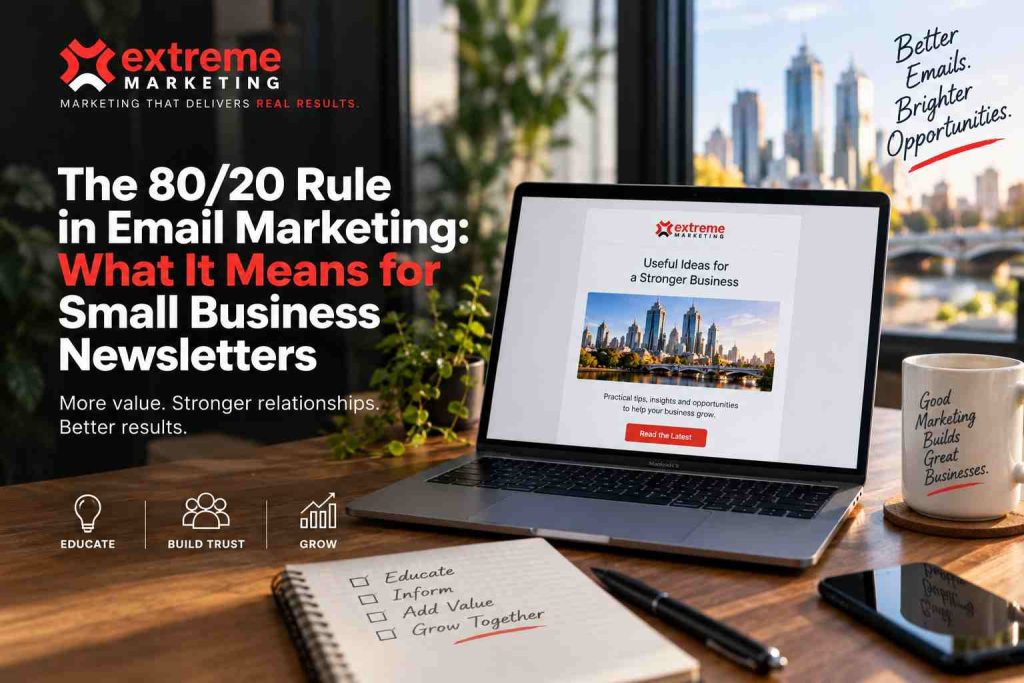
The 80/20 Rule in Email Marketing: What It Means for Small Business Newsletters
Small Business Newsletters
If every email from your business feels like a sales pitch, your subscribers will notice.
And eventually, they may stop opening.
That is where the 80/20 rule can be useful.
The basic idea is simple: most of your newsletter should give people something useful, interesting or genuinely helpful, while a smaller portion can focus directly on selling.
It is not a rigid mathematical formula. Think of it as a rule of thumb for keeping your emails valuable instead of turning every send into an advertisement.
H2: What is the 80/20 rule?
In email marketing, the 80/20 rule generally means around 80 per cent of your content should provide value to the reader, while around 20 per cent can be promotional.
Value can come in different forms.
- Useful advice
- Educational content
- Industry updates
- Practical tips
- Helpful resources
- Behind-the-scenes content
- Customer stories
- Answers to common questions
The promotional side can include:
- A new product
- A special offer
- A service
- An upcoming event
- A consultation
- A new collection
- A limited-time promotion
The point is not to count every sentence and make sure exactly four out of five are non-promotional.
The point is to give your subscribers a reason to keep hearing from you.
Why does this matter for small businesses?
Small business newsletters often have one big advantage over large corporate campaigns.
They can feel personal.
Your subscribers may know the owner, the team, the local business or the story behind the brand.
That gives you an opportunity to create emails that feel useful, not mass-produced.
But there is also a temptation to use every newsletter as a sales opportunity.
That can make your list feel like a noticeboard for promotions.
If every message says buy this, book this or call us now, subscribers have little reason to stay engaged between purchases.
A stronger approach is to build the relationship first, then sell when you have something genuinely relevant to offer.
What counts as valuable content?
Value does not have to mean writing a 2,000-word newsletter every week.
For a small business, useful content can be remarkably simple.
A local accountant could explain one common tax mistake.
A retailer could share three ways to choose the right product.
A trades business could explain what customers should check before booking a job.
A professional service business could answer a question that comes up in sales conversations every week.
The best starting point is often your customers themselves.
What do they keep asking?
What causes confusion?
What do they need to know before buying?
Those questions can become newsletter content.
Your newsletter should not be 80 per cent filler
This is an important distinction.
The 80/20 rule does not mean you need to pad your emails with random tips just to avoid selling.
If you have something genuinely useful to promote, promote it.
The problem is not selling.
The problem is sending content that gives the reader no reason to care.
A useful promotion can still provide value.
For example, instead of simply saying:
“Our new service is now available. Book today.”
You could explain what problem the service solves, who it is for, what has changed and why a customer might benefit.
The offer becomes part of a useful message rather than the entire message.
A simple newsletter structure
If you are not sure how to apply the 80/20 rule, try a simple structure.
- Start with one useful idea
- Explain why it matters
- Give the reader a practical takeaway
- Introduce a relevant product or service
- Finish with one clear next step
That gives the newsletter a natural flow.
The reader gets something useful even if they are not ready to buy today.
The business still gets an opportunity to generate enquiries or sales.
Five newsletter ideas that follow the 80/20 approach
1. Answer a question customers ask all the time
Turn a common sales question into a short email.
This is one of the easiest ways to create useful content because you already know the topic matters to your audience.
2. Share a practical tip
Give subscribers something they can use immediately.
Keep it specific. One strong tip is often more useful than a long list of generic advice.
3. Show how something works
Take people behind the scenes.
Explain a process, show how you prepare an order, walk through a service or explain what happens after someone contacts your business.
4. Share a customer story
A good customer story can educate and sell at the same time.
Focus on the problem, the solution and the result rather than turning the email into a collection of claims.
5. Curate useful resources
Share a small collection of tools, articles, ideas or resources that your audience would actually appreciate.
The key word is actually.
Do not send links just to fill space.
What about sales emails?
The 80/20 rule does not mean promotional emails are bad.
Sometimes the right email is a sales email.
If you have a genuine offer, a seasonal promotion, a new product or limited availability, your audience may appreciate being told about it.
The better question is whether the promotion is relevant.
A subscriber who has shown interest in a particular product should not receive the same message as someone who has never interacted with it.
Relevance makes promotional content much easier to accept.
Segment your audience when you can
You do not always need a complicated email system to improve relevance.
Even basic segmentation can help.
- New subscribers
- Existing customers
- Past customers
- People interested in a particular product
- People who have not purchased recently
- Local customers
- Business customers
The more relevant the message, the less you need to rely on constant promotion.
Do not obsess over the 80 and the 20
The ratio is a guideline, not a rule that your email platform needs to enforce.
Some businesses may find that 70 per cent useful content and 30 per cent promotional content works well.
Others may sell products where more frequent offers make sense.
Your audience, buying cycle and business model all matter.
A better measure is whether subscribers keep engaging and whether your emails drive business results.
What should you measure?
Open rates can provide useful information, but they are not the whole story.
For a small business, look at the actions that matter.
- Clicks
- Website visits
- Enquiries
- Bookings
- Purchases
- Revenue
- Unsubscribes
- Replies
If a newsletter gets fewer opens but generates several qualified enquiries, it may be more valuable than a newsletter with a high open rate and no commercial outcome.
That is why email marketing should connect back to business goals rather than vanity metrics alone.
A simple 80/20 newsletter example
Imagine a Melbourne landscaping business sending one newsletter each month.
The useful portion could include:
- Three ways to prepare a garden for summer
- A short guide to choosing low-maintenance plants
- A customer story showing a completed garden transformation
The promotional portion could then introduce a seasonal garden maintenance package.
The promotion makes sense because it follows information the reader can use.
It doesn’t feel like the business appeared in their inbox just to ask for money.
Email marketing works better when the relationship comes first
Your email list is not just a list of people you can advertise to.
It is an audience that has chosen to hear from your business.
That is valuable.
Give people a reason to stay subscribed.
Teach them something.
Help them make a decision.
Show them something interesting.
Then, when you have something worth buying, they are more likely to pay attention.
Want this applied to your business?
Start with a free website audit. A real person reviews your site and sends three quick-win fixes within 48 hours.
Get my free website audit