
Insights / Costs & Pricing
Custom Software vs. Off-the-Shelf: The Real Cost Comparison for SMEs
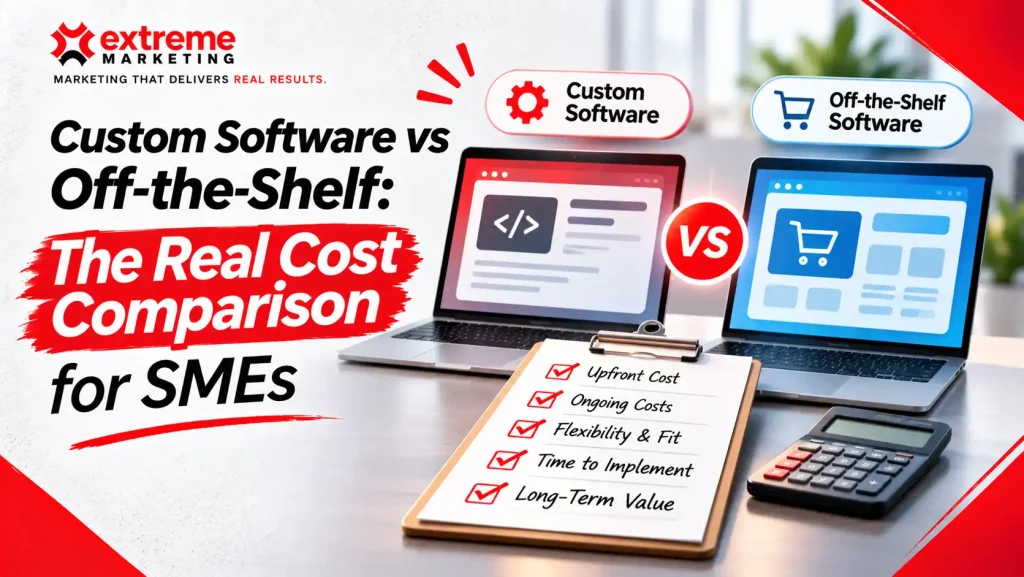
Off-the-shelf software looks cheaper. A monthly subscription versus a five- or six-figure build isn’t much of a contest on day one.
But businesses rarely compare day one. They live with the choice for five years or more. And over that time, the numbers can look very different.
What we mean by each
Off-the-shelf (or SaaS) is software built for many businesses and rented by the month. Think Xero, ServiceM8, HubSpot, Cliniko, Shopify.
Custom software is built specifically for your business. You own it, and it does exactly what you need.
There’s also a middle path: off-the-shelf tools connected with custom integrations. More on that later.
The case for off-the-shelf
Let’s be fair. Off-the-shelf is the right choice for many businesses.
- Low upfront cost. You can start this week.
- Proven. Thousands of businesses already use it, so the bugs are mostly ironed out.
- Updates included. New features arrive without extra cost.
- Support. Someone else handles hosting and security.
If a tool does 90% of what you need and your process isn’t what sets you apart, buy it. Don’t build accounting software.
The case for custom
Custom starts to make sense when:
- Your process is genuinely different, and that difference is why customers pick you.
- You’re paying for several tools that don’t talk to each other.
- Staff spend hours copying data between systems.
- Per user pricing is growing faster than your revenue.
- You need features no product offers.
The real cost comparison
Here’s a simplified example. A 20-person service business is considering replacing a stack of tools with one custom platform.
Note: These figures are illustrative to show how the comparison works. Your numbers will differ.
Off-the-shelf stack
- Job management tool: $60 per user per month
- CRM: $40 per user per month
- Booking and forms tool: $150 per month
- Integration tool to connect them: $100 per month
That’s roughly $2,250 a month, or about $27,000 a year. Over five years, around $135,000, assuming prices don’t rise (they usually do).
Then add the hidden cost. Say staff spend 30 minutes a day each on workarounds and double handling. Across 20 people, that’s 10 hours a day. At $45 an hour, that’s around $100,000 a year in lost time.
Custom platform
- Build: say $80,000 to $150,000 depending on scope
- Hosting and maintenance: say $1,000 to $2,500 a month
Over five years, roughly $140,000 to $300,000 all in. And if it cuts most of that admin time, the savings can outweigh the build cost.
The point isn’t that custom always wins. It’s that subscriptions plus lost time are a real cost that rarely makes it into the comparison.
Hidden costs on both sides
Off-the-shelf hidden costs
- Price rises you can’t control
- Paying for features you don’t use
- Per-user pricing as you hire
- Workarounds and spreadsheets to fill gaps
- Data locked in someone else’s system
- The vendor changing or shutting down the product
Custom hidden costs
- Scope creep if requirements aren’t clear
- Ongoing maintenance and updates
- Dependence on your developer if you don’t own the code
- Time spent by your team during discovery and testing
Ownership matters a lot here. If you build custom, make sure you own the source code. We cover this in how to choose an app development company.
The middle path: integrate what you have
You don’t always have to pick one. Many businesses keep their core tools (accounting, payroll) and build a custom layer on top. That might be a client portal, a quoting app or a dashboard that pulls everything together.
Some examples of this in practice:
- A quoting and invoicing app for tradies that pushes jobs straight into Xero
- A client portal for an accounting or law firm
- An ordering app for a restaurant that cuts delivery platform commissions
What about no-code tools and AI?
No code builders and AI tools can fill some gaps cheaply, especially for internal tools and prototypes. They have limits around scale, security and complex logic. Read no code app builders vs custom development and can AI actually build you a website for an honest view.
A simple decision checklist
Lean towards off-the-shelf if:
- A product meets most of your needs today
- Your process is fairly standard
- You have a small team
- You need something running this month
Lean towards custom if:
- Your process is a competitive advantage
- You’re juggling three or more disconnected tools
- Admin and double handling are eating hours each week
- Subscription costs keep climbing with headcount
Next steps
If you’re leaning custom, start with what custom app development really costs in Australia, then how to choose an app development company.
Or talk to us directly. As a custom web app development company in Melbourne, we’ll tell you honestly if an off-the-shelf tool would serve you better.
FAQ
Is custom software more expensive than off the shelf?
Upfront, yes. Over five years, not always. Rising subscriptions, per-user fees and time lost to workarounds can make off-the-shelf more expensive in the long run.
When should a small business build custom software?
When your process sets you apart, you’re juggling several tools that don’t connect, or staff lose hours each week to manual work.
Can I combine custom and off-the-shelf software?
Yes. Many businesses keep tools like Xero and build a custom portal or app that connects them.
Who owns custom software?
You should. Make sure your contract transfers full ownership of the source code to your business.

Want this applied to your business?
Start with a free website audit. A real person reviews your site and sends three quick-win fixes within 48 hours.
Get my free website audit